Do you know what AI is telling candidates about your company? Get your free report


An Employer Brand & Experience Studio
Giving Talent Teams the Design & Marketing Support They Deserve
We help Talent Acquisition teams build employer brands, design candidate experiences, and run recruitment marketing that attracts the right people - not just more of them.



The Best Talent Teams
Think Like Marketers
The people you bring in will shape your culture, build your products, and determine where the business goes. That work deserves the same level of marketing and creative support as any other function in the business.When your story is sharp, your experience is intentional, and your marketing is working - here's what changes:
Better candidates: More qualified applicants in the pipeline - and fewer who aren't a fit
Higher acceptance rates: Candidates who already believe in the brand before the offer lands
Lower turnover: Better-fit hires who knew exactly what they were signing up for
Less time per req: The right people are already paying attention before the role even opens
Reduced outside spend: Less reliance on search firms and job boards that scale cost with volume
How We Help Teams Like Yours
At Scout, we give TA leaders the marketing support they deserve. Let us handle the heavy lifting so you can focus on what you do best - hiring the right people for your company.
Employer Branding
Employer Brand Audits & Perception Research
EVP Development & Messaging
Employer Brand Launch & Employee Advocacy
Candidate Experience
Candidate Journey Mapping & Touchpoint Audits
Candidate Communications & Job Descriptions
Interview Experience & Hiring Team Enablement
Recruitment Marketing
Career Site Strategy & Development
Recruitment Marketing Campaigns for Hard-to-Fill Roles
Social Media & Employee Content Development
Insights
Ideas on employer brand, candidate experience, recruitment marketing - and what it actually takes to win talent right now.

The CRAFT Framework: Five Practical Steps to a Candidate Experience That Wins Top Talent
A simple, five-step system any recruiting or employer brand team can use to build a candidate experience that actually delivers on the promise of your company.

AI Doesn't Fix a Weak Employer Brand. It Exposes One.
AI can't write your story for you - it just scales whatever you already have (for better or worse). Here's why the honeymoon phase with recruiting AI is wearing off, and what to fix before you optimize the tools.

The Real Cost of DIY Employer Branding at Your Company.
When every recruiter builds their own version of the pitch, candidates notice - and it costs your team more than you'd think. A look at the hidden price of DIY, plus a free calculator to see what it's costing you.
Real Client Results
160%
increase in career site traffic year
over year. (Cornerstone OnDemand)
2x
apply conversions after aligning
brand and experience. (Irvine Company)
20%
faster time-to-fill, without
adding headcount. (Irvine Company)
Want to learn more?
Book a Free
30-Minute Call
A quick, no-pressure call to talk through what your team is working on and whether Scout is the right partner to help. Either way, we'll make sure you leave with something helpful you can use right away.
How it works
Book a time
Grab a spot on the calendar that works for you.We come prepared
We'll take a look at your current setup before we talk.Leave with something useful
Even if we're not the right fit, you'll walk away with a clearer picture of where to focus.
Would you rather send us a note?
Email us at: [email protected]

Our Team
Meet the Team
We're a small group of experts, on purpose. Big enough to take on any challenge, while nimble enough to move fast and stay close to the work - so every project gets our full attention.

Nolan Reiter
Founder & Principal

Caitlin Reiter
Founder & Head of Content

Peter Kotvis
Head of Strategy

Tanya Garner
Designer

Forrest Williams
Designer

Jeffrey Jones
Videographer & Motion Designer
Why we exist.
We started Scout because we believe Talent Acquisition has one of the most important jobs in any company.The people you hire are the people who grow the business. They build the product, shape the culture, and solve the problems that decide where the company goes next. Every one of them came through a door that TA opened.That work deserves more support than it usually gets. Not because it's hard — though it is — but because of what's actually at stake. A hire isn't a transaction. It's a decision that shapes a company for years.We think that makes this some of the most meaningful work there is. Helping a person find the job that's right for them, and helping a company find the people who will build its future — that's work worth doing well, every single day.
Our convictions.
TA is the most important function in any company.
Every decision a company makes is downstream of who they hired. Someone has to find those people with intention. That's not an administrative task. That's the most consequential work in the business.Trust is the foundation under every employer brand.
When a company's employer reputation breaks down, it's almost never a messaging problem. It's broken promises, an unclear strategy, or leadership that says one thing and does another. You can't cover up a trust problem with better creative or better words — the work has to start further upstream.Likability is cheap, and easy to copy.
Most employer brand work chases likability — a fun culture video, a friendly tone, a wall of smiling faces. But likability doesn't set you apart. It's exactly why so many employer brands start to sound the same. What actually earns trust is being believed — how you prove what you're saying is true.Most TA teams are expected to be marketers, but without the resources to succeed.
The creative and strategic resources that exist for sales and marketing almost never exist for recruiting. That gap is the problem Scout was built to close.Clarity beats technology every time.
The companies winning talent right now aren't the ones with the best tools. They're the ones with the clearest sense of who they are. A clear, compelling story is the most powerful recruiting advantage you have.Your employer brand is only as strong as the worst touchpoint in your hiring journey.
You can have a beautiful career site and a compelling pitch — and then send a form rejection with no name on it. Candidates feel that gap even when they can't name it.
How we work.
Effective talent attraction happens when three things are working together — in the right order. Most teams come to us somewhere in the middle. They need a new career site, a job description refresh, or a campaign for a hard-to-fill role. We'll start there. But the first thing we do is make sure the foundation is solid before we build anything on top of it.1. Employer Brand
This is the story of what it's like to work at your company, and your reputation as an employer. That includes your career site, but it also includes what AI tools are saying about you, and what candidates find when they search you on Glassdoor or Blind. Everything else builds on top of this. If it isn't clear, nothing downstream works the way it should.2. Candidate Experience
Once the story is sharp, the next question is whether candidates can actually feel it. Every touchpoint in the hiring process — the job post, the confirmation email, the interview, the offer letter — is either building up your employer brand or taking away from it.3. Recruitment Marketing
Once the story is right and the experience is cohesive, then — and only then — you scale. Good marketing amplifies what's already working. That's why it should be the last stop, not the first.
Who we typically work with.
We work with Talent Acquisition leaders at U.S.-based companies, usually between 2,500 and 10,000 employees. Most are already using the latest technology and AI, but they aren't seeing the results they hoped for — more software has often meant more complexity, and less connection with the people they're trying to hire.We work in two ways:Embedded Support
Ongoing access to our full team of creative and marketing experts. We act as an extension of your own team — not a vendor you check in with once a quarter.Project-Based Engagements
For specific, high-impact needs. This includes building your employer brand strategy, refreshing your career site, or running a targeted campaign for hard-to-fill roles.
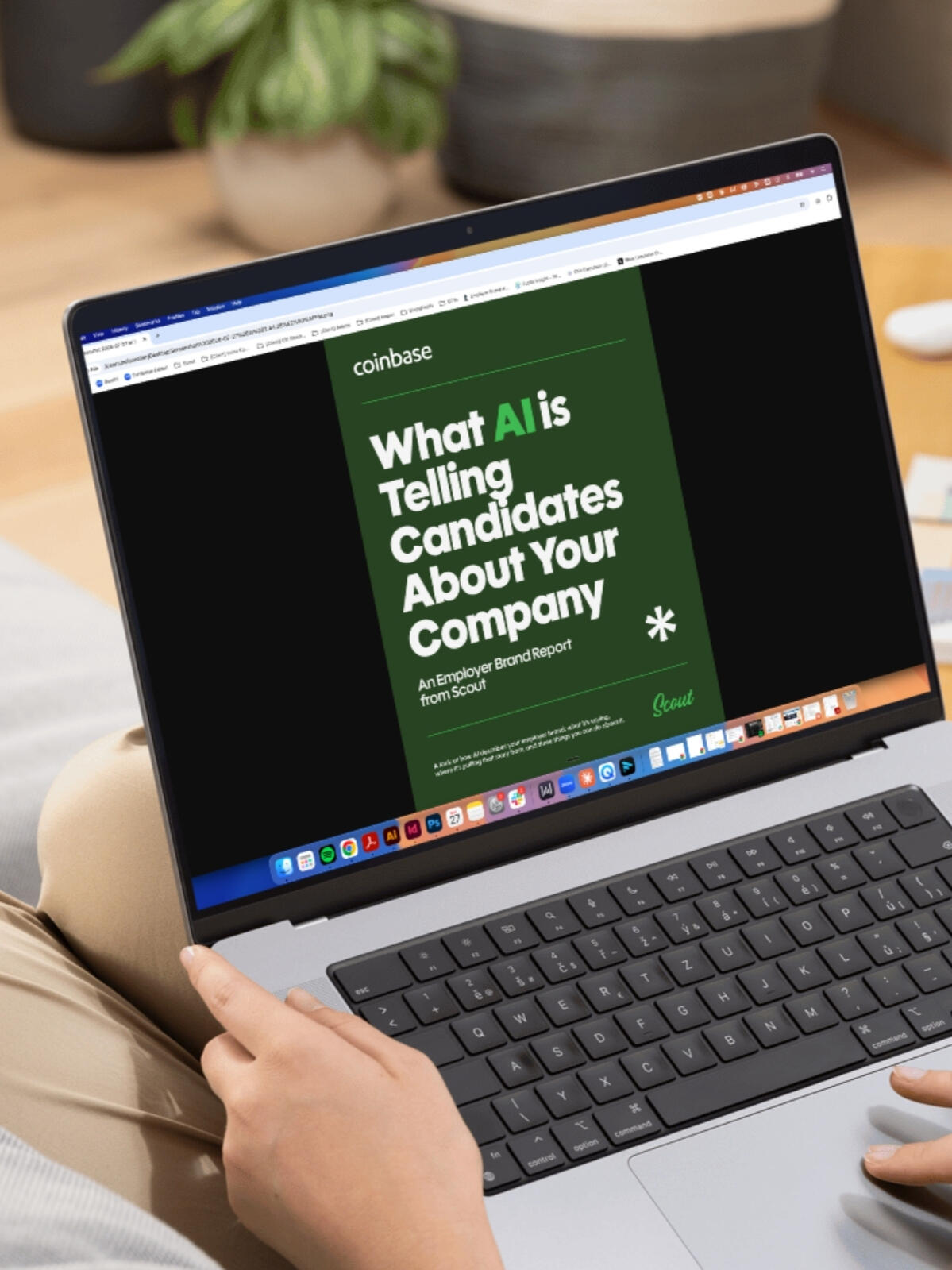
Find out exactly what AI is telling candidates about your company.
Candidates are researching companies using AI before they ever talk to a recruiter. We'll show you exactly what they find, where it's coming from, and three things you can do about it.Here's what you get with your free, personalized report:
Every source AI uses to tell your story - ranked by influence
How you compare to competitors on AI visibility
What's coming through positively and negatively
Three things you can do this week to improve your standing
Get Your Free Report
Free. Personalized to your company.
Delivered in 24 hours.

You can't fix what you can't see.
40% of candidates rely on AI to help evaluate companies, but most TA teams don't know what it's saying.In 24 hours, you'll know exactly what AI is telling your candidates, which sources are driving the narrative, how you stack up against competitors, and three specific things you can do to help improve the story.
How it Works
1. Submit the form
Fill out the form above to tell us your company name and email - it takes about 10 seconds.
2. We build your report
We research what AI is saying about your employer brand and put it into a clean, easy-to-share report.
3. Get your PDF + video
Within 24 hours, you'll receive your personalized report and a short video walking you through exactly what we found.
Orange County, California | Copyright Scout Studio LLC, 2026
Almost there!
While we start working on your report, please take a minute to answer a few more questions to help make it a lot more useful for you specifically.
Check out a sample report walkthrough:
If you want to talk through what we find in your report, or just get a sense of whether Scout might be a good fit for your team, grab some time below. No agenda - just a real conversation.

Orange County, California | Copyright Scout Studio LLC, 2026
Insights
AI Doesn't Fix a Weak Employer Brand. It Exposes One.
The companies hiring the best talent right now aren't the ones with the shiniest recruiting tools. They're the ones who did the slower, harder work of figuring out what's actually true about working there, and say it clearly.
Nolan Reiter | May 2026

Don't worry - our AI recruiting bot is here to save us!
There has been a lot of excitement over the past few years about what AI can do for recruiting. The promise of doing more with less is real, and is an especially appealing offer for TA teams that have been asked to take on more and more every year.But I'm starting to wonder if the honeymoon phase is wearing off.If everyone is using the same tools, sorting through the same talent pools now filled with AI-generated resumes and cover letters, where exactly is the differentiation coming from? More technology hasn't made hiring easier - it's just made everything louder.Your employer brand is the last moat. How clearly you can articulate the real challenge your company is inviting people to take on (and exactly what makes that challenge worth it) is the most direct path to attracting and hiring the people who will grow the business.
What AI actually does.
AI is not a creative force. It does not invent meaning or manufacture differentiation or figure out why someone would thrive at your company vs. the one down the street. What it does, and does really really well, is take whatever already exists and move it further and faster than you could on your own.If what exists is sharp and specific and honest, that’s a real advantage. You can reach more of the right people, more efficiently, with a message that actually resonates. But if what exists is generic - the kind of carefully approved, safe-for-everyone language that most employer brands eventually become after enough rounds of review - then AI just moves that further and faster too. The funnel gets bigger, the quality gets thinner and it becomes hard to understand why all of these AI tools aren't working the way we thought they should.
How brands lose their edges.
I don’t think most companies set out to have a generic employer brand. In my experience, the original thinking is often really good. Someone did the work, talked to employees, found the honest and specific things that make the company worth joining - the real challenges, the genuine rewards, the kind of person who thrives there vs. the kind who doesn’t.But then.... legal reviews it. Leadership weighs in. Someone from marketing wants to make sure it’s consistent with the consumer brand. Someone else is worried it might exclude a candidate group if it’s too specific. Each round of feedback is well-intentioned, and each round sands down another edge, until what started as something differentiated becomes something that applies everywhere and therefore says nothing about anywhere. The people who made it through that process feel like they accomplished something, because getting it approved was genuinely hard work. What got lost along the way is harder to see from the inside.
The only thing that cuts through.
What I keep coming back to, after all the career site reviews and all the conversations with TA leaders, is that the companies doing this well are not necessarily the ones with the best tools or the biggest budgets. They are the ones that did the harder, slower work of figuring out what is actually true about working there. Not the aspirational version, not the version that got approved, but the honest version - the real challenge they are asking people to take on, the specific kind of person who would find that challenge meaningful, the genuine reasons someone would stay and grow and do their best work inside that particular company.When you know those things with clarity and can say them plainly, everything downstream gets easier. The job descriptions write themselves more honestly. The outreach feels less like noise because it’s actually specific. The candidates who respond are more likely to be the right ones because the message was designed for them, not for everyone. And then, when you layer the tools on top of that foundation, they actually deliver on what they promised, because now they are scaling something worth scaling.
What I’d suggest before anything else.
If you are considering adding more AI to your recruiting process, or you already have and you’re starting to feel like the results aren’t quite what you hoped, I’d encourage you to pause before optimizing the tools and spend some time on the foundation first. Ask the honest questions. What is the actual challenge you are inviting people into? What kind of person genuinely thrives in your environment, and what kind of person doesn’t? What would a great hire say a year in about why they’re glad they joined?Those answers exist inside your company right now. They’re in the heads of your best employees and your best managers. They just haven’t been found and shaped and said clearly yet. It’s not glamorous, but it’s the one thing that makes everything else worth doing.AI will scale whatever inputs you give it. Make sure what you give it is something real.
Before you go
Free Report: What is AI telling candidates about your company?
40% of candidates rely on AI to help evaluate companies, but most TA teams don't know what it's saying. We'll put together a free, personalized report outlining what AI is telling candidates about your company - and what you can do about it.
Insights
The Real Cost of DIY Employer Branding
Plus a free calculator to help uncover the hidden costs of DIY on your TA team
Nolan Reiter | October 2025

I wonder if he plans to DIY his employer brand too?
When I led employer brand and recruitment marketing in-house, I saw firsthand how hard it was to get support from internal (or external) resources.Internal marketing teams were always too focused on supporting sales and product priorities, and external agencies rarely understood what TA teams really needed.But here’s the thing: Talent Acquisition teams play one of the most important roles in any organization. They’re building the teams that build the business. That deserves real, thoughtful marketing support.That’s actually the story behind why I started Scout – to give TA teams the design and marketing support they deserve. And the reality is, the most cost-effective way to make that happen isn’t more DIY, but to partner with a team that can help you scale - while delivering a return on your investment.Let me explain -
The hidden cost of DIY recruitment marketing
When recruiters spend hours each week creating or tweaking materials, that’s time they’re not spending with candidates. Over time, it adds up – in both hours and missed opportunities.But the bigger issue isn’t time – it’s consistency.When every recruiter is building their own version of the company pitch, candidates experience multiple versions of your employer brand. Different visuals. Different tone. Different promises about culture and opportunity that may (or may not) resonate with the candidate you’re talking to.That inconsistency doesn’t just look unpolished – it creates doubt. Candidates are building an impression of what it’s like to work at your company - and will wonder: Is this really what it’s like to work here?At Scout, we call this Recruitment Debt – the compounding effect of quick fixes, mismatched touchpoints, and underinvestment in the candidate experience over time.
Three signs it’s time to bring in support
1. Your recruiters are acting like designers.
If your team is spending time creating net-new materials in Canva, it’s a signal. Recruiters should be spending as much time as possible connecting with people, not figuring out how to update a social post template.2. Your employer brand looks different everywhere.
Outdated logos, inconsistent messaging, rogue slides – these aren’t small issues. They create friction and erode trust. Some of these things you can’t even see as a recruiter without going through the application process yourself.3. Your marketing team keeps saying “next quarter.”
If your timelines depend on another team’s priorities, you’ll always be behind. Hiring moves fast - and your creative partner should too.
What changes when you invest in creative support
Trusting design, copywriting and storytelling to a dedicated partner isn’t about handing off busywork. It’s about building a consistent, scalable system that protects recruiter time and improves the candidate experience.The return will show up quickly:Time saved: Recruiters get hours back each week.Faster hiring: Cohesive materials convert candidates more effectively.Brand trust: Every touchpoint tells the same story.The reality is, creative support isn’t a nice-to-have – it’s a multiplier. The right partner gives your team tools, templates, and structure that not only save time but elevate the candidate experience across the board.
Try it for yourself.
If you’re curious what DIY recruitment marketing is actually costing your team, I put together a DIY Recruitment Marketing Cost Calculator you can use. Answer two simple questions to find out how many hours (and dollars) are being lost to design and content work your recruiters shouldn’t be doing.
Before you go
Free Report: What is AI telling candidates about your company?
40% of candidates rely on AI to help evaluate companies, but most TA teams don't know what it's saying. We'll put together a free, personalized report outlining what AI is telling candidates about your company - and what you can do about it.
Insights
The CRAFT Framework: Five Practical Steps to a Candidate Experience That Wins Top Talent
A simple, five-step system any recruiting or employer brand team can use to build a candidate experience that actually delivers on the promise of your company. No matter your team size, budget, tech stack, or where you are in your employer brand journey.
Nolan Reiter | November 2026

Don't worry, this (seemingly) random photo of a drink will make sense by the end
Free Resources
Build a standout candidate experience without a huge budget or team.
Sign up and receive free tools and resources that walk you through each step of the CRAFT framework.
The CRAFT Framework Overview
CRAFT is a practical, five-step system for anyone to build a truly unique and differentiated candidate experience. It's how we work with recruiting and employer brand teams at Scout, and it works no matter your company size, budget, or how far along you are with your employer brand.C - Chart every touchpoint
R - Review for gaps
A - Align to your EVP
F - Focus and elevate
T - Train and equipIn short, you start by zooming out to see the whole journey, find where it breaks down, decide what it should feel like, add the moments people remember, and give your team what they need to deliver it every time.A quick note on the importance of candidate experience:Before we jump into step one of the CRAFT framework, I want to quickly emphasize one point: candidate experience is your company's biggest competitive advantage right now.When I say candidate experience, I mean every touchpoint and everything a person feels as they move through your hiring process. Every email, conversation, automated message, AI response, and Glassdoor review (whether you control it or not).Most TA teams today have access to the same AI, the same tech, and the same job boards. So the experience you create is one of the only things left that sets you apart. It's also the first real chance you get to prove that what you say about your company is true.I've noticed a lot of teams put tons of work into their messaging. But it's actually proving that messaging in those critical first interactions that leads to higher offer acceptance, better candidates, and more growth for the business.And the moments that matter most usually aren't the big, flashy ones. Employer/candidate trust gets built in the little details over time:• How you communicate
• How you make people feel
• The steps involved
• How you respect people's timeEach one is a small preview of how you'll treat people once they're employees - and the CRAFT framework is how you'll make sure your candidate experience actually delivers on the promise you're making to candidates.
Step 1: Chart Every Touchpoint
The first step is to build a complete map of every moment a candidate encounters your company, from first impression to final offer.It doesn't have to be fancy. A living doc or spreadsheet works great. But having this list is such an important asset when you're ready to invest in your candidate experience.And don't judge anything yet. The goal here is just to take stock of the journey and get it all on paper. The reality is you can't improve (or even assess) what you can't see, and a lot of teams don't have a documented list of the touchpoints and messages candidates receive.Some systems may be owned by HR Ops or IT, and that's okay. For now, just map the ones you own.Designed vs. DiscoveredWhen I say chart everything, I want to make sure we're looking at the full picture. I like to frame it as Designed vs. Discovered.Designed touchpoints are the ones you have control over:• Job posts and job boards
• Career site
• Recruiter outreach and comms
• System emails (updates, rejections, etc.)
• Interview experience
• Offer and pre-boarding comms
• Hiring manager interactions
• Culture and office experienceThese are the places where we should always work hardest to create a consistent, brand-aligned experience, because they feed right into the second group.Discovered touchpoints are the things candidates find on their own:• Glassdoor
• Indeed reviews
• Blind
• LinkedIn
• Reddit and online forums
• Employee-generated content
• News and press coverage
• AI toolsThis is where your employer brand reputation has to stand on its own (like the old adage: your brand is what people say about you when you're not in the room).
Step 2: Review for gaps
Once you've mapped your Designed and Discovered touchpoints, it's time to switch hats from observer to evaluator. Where in the process are things breaking down? Where are the gaps, or maybe the overlaps?Here's an example. We were doing this with a client who had been on SuccessFactors for years. It wasn't until we charted out the full process that we realized candidates were getting emails with an old logo from an internal system. Imagine applying for a job and then getting an email with some random logo at the top. It's confusing, and it doesn't make for a great experience.The good news is there are some really great platforms (like Paradox and others) that guide candidates through the whole process and make it easier to control the brand and messaging.Five things to review at every touchpointHere's a simple way to evaluate any touchpoint, new or existing.1. Clarity. Does the candidate always know what happens next? For example, does your post-application email explain the next steps?2. Brand alignment. Does this sound like us? Or does it sound like a template, a different company, or any company?3. Friction. Is this harder than it needs to be? The application process is a great place to start.4. Communication. Are we respecting their time? Are we reaching out proactively, or making them chase us?5. Measurement. Are we collecting any data or feedback at all? Think candidate NPS, drop-off rates, and offer acceptance trends.
Step 3: Align to your EVP
You've mapped the experience and found the gaps. Now it's time to run every touchpoint through the filter of your Employee Value Proposition.The reality is that your EVP is a promise. And every candidate touchpoint, especially the ones you design, is a chance to keep that promise and build trust.A quick note: if your EVP isn't fully built yet, that's okay. You can filter everything through your company's mission, vision, and values. Or just start with the overall feeling you want candidates to have, and how you want to be seen as an employer. That's enough to work from.Marbles in a jarBrené Brown talks about trust like marbles in a jar. Every small thing you do over time adds a marble.• You let people know what to expect from the process. Marble in.
• You follow up when you said you would. Marble in.
• You send updates every few days so the candidate doesn't feel ghosted. Marble in.Every touchpoint you mapped in the first two steps becomes one of these marble moments. And when it comes time to make an offer, the company with the most marbles in the jar usually wins.The teams that get this right have figured out how to make these trust-building moments happen consistently, on purpose, and often (with the help of technology) at scale.
Step 4: Focus and elevate
This is one of my favorite steps, because it's where we get to do the fun, human, truly different things. The stuff AI can't do on its own.This step is about prioritizing the moments with the most emotional weight, then adding unexpected, above-and-beyond touches that make your company memorable.The truth is, you can't fix everything at once. But even one well-designed moment can change how a candidate feels about your company, and whether they accept your offer.Look for your drink umbrella momentsBree Groff has this idea about drink umbrellas. When you think about it, what's the point of that little umbrella? It serves no purpose other than to delight the person holding the drink.And yet it signals so much. It marks a celebration, lightens the mood, and brings a little happiness to the person holding it, all for so little. Bree even talks about how her husband will put one in her morning coffee, and it totally makes her day.So it's worth asking: are there any little umbrella moments you could add to your hiring journey? Any places where something small could make an outsized impact?A few ideas to get you thinking:• A personal video from the hiring manager introducing themselves before the first interview
• A thoughtful note with real feedback alongside a rejection
• Something fun that shows your personality. PostHog has a chart all over their site showing how many people on the team like pineapple on their pizza. I still remember it.I love how Bree puts it: "Delight is at once never necessary... and also the most necessary." With so much happening around AI and technology, these small human moments are only going to matter more.
Step 5: Train and equip
The last step is about building the tools and resources your recruiting team needs to carry the brand consistently.You could argue this is the most important step. You can have an amazing EVP deck and messaging, but none of it matters if it's applied unevenly and no one knows how to bring it to life across the candidate experience.The 80/20 rule: structure without rigidityHere's how I like to think about it.A game plan for 80% of the experience. This creates consistency, fairness, and steady quality across every recruiter, every role, and every hiring manager. It's the baseline that makes sure no candidate gets a wildly different experience depending on who they happen to talk to first.A flexible library for the other 20%. This is content and resources for the moments that need a little more of an art form. Do you need resources that help candidates self-select early in the process? Something to keep a candidate warm during a long interview process? Extra support for a competitive offer situation at the end?No two candidates are the same. Great recruiters know which lever to pull and when. Our job is to give them the tools to do it consistently, in a way that's true to the brand.
CRAFT for your situation
Not everyone is starting from the same place. This framework works at any stage, but how you apply it might look a little different depending on where you are.What if our EVP isn't built out yet?
Don't let that stop you. You don't need an expensive, polished brand system to start this work. If you have a mission, vision, and values, use those. If not, just jot down a few things you want candidates to feel throughout the process. That gives you a north star to work toward, and a promise to deliver on.What about high-volume hiring?
If personalized rejection emails don't feel realistic at your volume, that makes complete sense. I'd focus your energy on charting and reviewing for gaps first. Small fixes at scale make a real difference, and not everything needs to be personalized to feel intentional. You can still automate a lot of the process in a way that reflects who you are, and deliver it consistently. Then save the human touch for the moments where it will really stand out.What if I don't have much control over the process?
A good place to start might actually be Train and Equip. Building a simple recruiter toolkit is easier than it seems, and it can go a long way toward a consistent, trust-building candidate experience.The main point is this: no matter where you are or what your budget looks like, this system can work for you, right now.
Keep it simple
So that's CRAFT. Five steps for any team, any budget, and any stage of the journey.I hope this feels simple, because it is. This isn't a complex method that needs a full-time commitment and a six-month roadmap. It's just a way of capturing and elevating the experience we create for candidates, so we can bring in the people who will take the business to the next level.It rarely takes something big. It mostly takes paying close attention.
Before you go
Free Report: What is AI telling candidates about your company?
40% of candidates rely on AI to help evaluate companies, but most TA teams don't know what it's saying. We'll put together a free, personalized report outlining what AI is telling candidates about your company - and what you can do about it.